
BLOG
“Ehi, Vuoi Da Bere?” — Your Complete Guide to the Italian Phrase That Opens Hearts and Homes

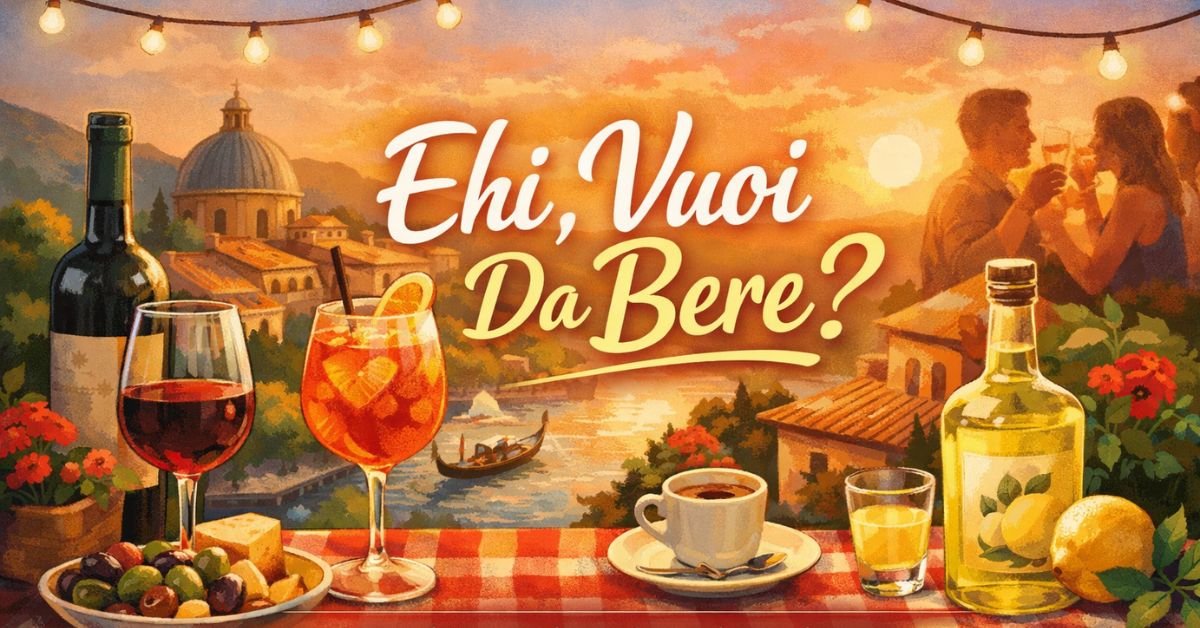
Few phrases in the Italian language carry as much social weight as “Ehi, vuoi da bere?” — literally, “Hey, would you like something to drink?” On the surface, it is a simple offer. In practice, it is an act of welcome, an opening of doors, and one of the most authentic expressions of Italian culture you will encounter.
Whether you are planning a trip to Italy, deepening your language skills, or simply curious about what the phrase means in its full cultural context, this guide covers everything: its translation, its traditions, the drinks you might be offered, the etiquette expected of you, and how it appears in Italian pop culture.
What Does “Ehi Vuoi Da Bere” Really Mean?
The Literal Translation vs. The Cultural Heartbeat
Word for word, “Ehi, vuoi da bere?” translates as: “Ehi” — hey; “vuoi” — do you want (from the verb volere, to want); “da bere” — something to drink (literally “to drink”).
The full English rendering is therefore: “Hey, do you want something to drink?” or more naturally, “Hey, would you like something to drink?” Simple enough. But the phrase operates on a second, deeper register — one that has less to do with beverages and everything to do with belonging.
More Than a Drink: It’s an Invitation to Connect
In Italy, offering a drink is rarely just about hydration. It is a social gesture, a signal that you are welcome in someone’s home or company, and that the person in front of you is worth a moment of their time. Hospitality — ospitalità — is embedded in Italian culture as a genuine value, not a formality.
When someone says “Ehi, vuoi da bere?”, they are inviting you into their social world. Accepting means joining the conversation, the company, the ritual. In this sense, the phrase functions almost like an extended hand — an offer of connection dressed as a question about drinks.
The Soul of Italy: Why This Phrase Is Culturally Significant
A Tradition Steeped in Warmth and Hospitality
Italian hospitality has deep roots, shaped by centuries of regional tradition, family life, and a culture that places enormous value on shared meals and communal experience. Unlike cultures where social interactions tend to be more reserved, Italians are generally warm and forthcoming with offers of food and drink — it is considered natural, even obligatory, to offer a guest something to consume.
The phrase “Ehi, vuoi da bere?” is part of this larger tradition. It signals that a guest is seen, acknowledged, and valued. Refusing without explanation can, in some contexts, feel slightly abrupt — though Italians are not unaware of different cultural norms and generally adapt gracefully.
The Social Ritual of Sharing a Moment
Beyond hospitality as a concept, the act of sharing a drink in Italy is a structured social ritual. There are specific drinks for specific moments of the day, specific ways to toast, and specific settings in which each type of drink belongs. Understanding this ritual gives the phrase “Ehi, vuoi da bere?” its full weight.
It is not just what you drink, but when, with whom, and how you drink it that matters. The phrase initiates this ritual and everything that follows — from the choice of drink to the conversation that unfolds around it — is part of a social choreography that Italians navigate with ease and pleasure.
A Journey Through Italian Glasses: What You Might Be Offered
If someone extends you the invitation of “Ehi, vuoi da bere?”, what you are offered depends heavily on the time of day, your setting, and the region of Italy you are in. Here is a comprehensive guide to the most likely candidates.
The Art of Aperitivo (Pre-Dinner Drinks)
The aperitivo is perhaps the most culturally iconic Italian drinking tradition. Held in the early evening — typically between 6:00 PM and 9:00 PM — it is a pre-dinner ritual combining light alcoholic drinks with small bites of food (the stuzzichini or cicchetti), designed to stimulate the appetite and ease the transition from the working day into the social evening.
In cities like Milan, Turin, and Venice, the aperitivo is an institution. If someone says “Ehi, vuoi da bere?” in an aperitivo bar or at a pre-dinner gathering, you are most likely being offered one of the following:
- Aperol Spritz — the ubiquitous orange-hued cocktail made with Aperol, prosecco, and a splash of soda. Refreshing, slightly bitter, and immediately recognizable.
- Negroni — a more sophisticated blend of gin, Campari, and sweet vermouth. Beloved in Florence, where it was reportedly invented.
- Campari Soda — a simpler, pre-mixed bittersweet aperitif, popular for its convenience and bold flavor.
- Prosecco — Italy’s celebrated sparkling wine from the Veneto region. Light, crisp, and extremely widely offered.
Italy’s Liquid Gold: A Guide to Regional Wines
Wine is inseparable from Italian identity. Italy produces more wine varieties than any other country in the world, and every region has its signature bottles. If you are offered a glass of wine after the question “Ehi, vuoi da bere?”, the choice will often reflect where you are.
| Region | Famous Wine | Character |
| Tuscany | Chianti, Brunello di Montalcino | Dry, full-bodied red; pairs with meat dishes |
| Veneto | Prosecco, Amarone | Sparkling and rich; from the foothills of the Dolomites |
| Piedmont | Barolo, Barbera d’Asti | Bold, tannic reds; known as “the wine of kings” |
| Sicily | Nero d’Avola, Marsala | Rich, sun-drenched reds and fortified wines |
| Campania | Falanghina, Greco di Tufo | Crisp, aromatic whites from volcanic soils |
| Friuli-Venezia Giulia | Pinot Grigio, Friulano | Elegant whites; among Italy’s finest |
The Daily Ritual: Italian Coffee Culture
Coffee in Italy is not merely a beverage — it is a philosophy. Italians drink coffee multiple times a day, but with strict, unspoken rules governing what is appropriate at which hour. If “Ehi, vuoi da bere?” is uttered mid-morning or after a meal, a coffee offer is entirely plausible.
- Espresso — the default. Short, intense, and drunk standing at the bar. The baseline of Italian coffee culture.
- Caffè Macchiato — espresso “stained” with a small amount of milk foam. A slightly softer option.
- Caffè Americano — espresso diluted with hot water. Widely available for international visitors.
Tip: The Unspoken Rule: Cappuccino is a morning drink. Ordering one after 11:00 AM — and especially after a meal — marks you immediately as a tourist. If you want to blend in, stick to espresso after lunch or dinner.
The Sweet and Bitter Finish: Digestifs and Liqueurs
After a meal, “Ehi, vuoi da bere?” might be an offer of a digestivo — a post-dinner liqueur intended to aid digestion. This is where the phrase takes on its most convivial and leisurely character: the meal is finished, the table is relaxed, and the evening is stretching pleasantly ahead.
- Limoncello — the bright yellow lemon liqueur from the Amalfi Coast and Sicily. Served ice cold, ideally from a bottle kept in the freezer.
- Amaro — a family of bitter herbal liqueurs with significant regional variety. Amaro Montenegro, Fernet-Branca, and Averna are among the most recognized.
- Grappa — a potent grape pomace spirit. Acquired taste; deeply traditional, especially in northern Italy.
- Sambuca — anise-flavored liqueur, often served with three coffee beans (“con la mosca”) floating on top.
Beyond Alcohol: Non-Alcoholic Offerings
Not every “Ehi, vuoi da bere?” leads to an alcoholic drink. Italy also has a strong tradition of distinctive non-alcoholic beverages, particularly in casual or family settings.
- San Pellegrino or Acqua Panna — sparkling or still mineral water, served at virtually every Italian table.
- Chinotto — a slightly bitter, dark soda made from the chinotto citrus fruit. Uniquely Italian and surprisingly complex.
- Limonata or Aranciata — San Pellegrino’s sparkling lemon or orange sodas. Light, natural, and widely loved.
When and How to Use “Ehi Vuoi Da Bere” (Like a Local)
Four Common Scenarios
The phrase appears naturally across a broad range of social situations. Here are the four most common contexts you are likely to encounter it:
Scenario 1: At Home (A Family Lunch)
You arrive at an Italian friend or colleague’s home. Before you’ve even sat down, someone from the family — often an older relative — will appear from the kitchen and ask, “Ehi, vuoi da bere?” The expected answer is something refreshing: mineral water, a light aperitif, or a local wine, depending on the time of day.
Scenario 2: At a Caffe or Bar
In Italian bars (which are more café than pub), the phrase may come from a host inviting a friend to join them. “Ehi, vuoi da bere?” in this setting is an invitation to stop, sit, and spend twenty minutes in good company over an espresso or a quick spritz.
Scenario 3: At Aperitivo Hour
If you’re meeting Italians in the early evening — in a piazza, at someone’s apartment, or at an aperitivo bar — the question will almost certainly be followed by an Aperol Spritz or Prosecco. This is peak social hour, and the phrase carries with it the full warmth of the tradition.
Scenario 4: After Dinner
The meal is over, the plates are cleared, but no one is in a hurry to leave. “Ehi, vuoi da bere?” now signals the digestivo round — a small glass of something herbal, sweet, or sharp to close the evening. Saying yes here means the evening continues.
Italian Drinks by Region: A Local’s Guide
One of the great pleasures of traveling in Italy is discovering that each region has its own drinking customs. The phrase “Ehi, vuoi da bere?” in Venice may result in a Bellini; in Naples, an espresso; in the Amalfi Coast, a Limoncello.
| Region | Signature Drink | Best Moment |
| Milan / Lombardy | Campari Soda, Negroni | Aperitivo hour |
| Venice / Veneto | Bellini (prosecco + peach), Spritz | Midday or early evening |
| Florence / Tuscany | Chianti, Negroni | With dinner or before |
| Naples / Campania | Espresso, Limoncello | Morning coffee or post-dinner |
| Sicily | Nero d’Avola, Granita di Limone | With meals or as a refreshment |
| Piedmont | Barolo, Vermouth di Torino | Aperitivo or with red meat |
Your Go-To Guide: Etiquette and How to Respond
The Perfect Reply: What to Say
When someone offers you a drink with “Ehi, vuoi da bere?”, the range of acceptable responses is broader than you might think. Italians are gracious hosts, but they appreciate genuine engagement over polite deflection.
- “Sì, grazie!” — Yes, thank you. The simplest and most welcome response. Always appreciated.
- “Cosa mi consigli?” — What do you recommend? This is an excellent phrase. It shows curiosity, deference to the host’s knowledge, and signals that you are genuinely interested in the local culture.
- “No grazie, sto bene” — No thank you, I’m fine. Perfectly acceptable, especially if you follow it with a warm smile and perhaps a reason (driving, preference, etc.).
- “Magari un’acqua” — Maybe just a water. A modest, entirely appropriate choice at any time of day.
5 Essential Dos and Don’ts of Italian Drinking Etiquette
- DO make eye contact when toasting. The Italian toast is “Cin cin!” or “Salute!” — and looking away during the clink is considered bad luck (and bad manners).
- DO wait until the host raises their glass before drinking. Starting before a toast is an informal breach of etiquette.
- DON’T order a cappuccino after 11:00 AM. Especially not after lunch or dinner. Espresso is the correct post-meal choice.
- DON’T refuse multiple times in quick succession. A single polite refusal is respected; repeated refusals can be read as a rejection of hospitality itself.
- DO try something local. If you’re in the Veneto and offered a Spritz, or in Sicily and offered a Limoncello — say yes. These are not just drinks; they are expressions of place and pride.
The Phrase in Pop Culture: From Vasco Rossi to Modern Italy
The phrase “Ehi, vuoi da bere?” has also found its way into Italian popular culture, most notably through the music of Vasco Rossi, one of Italy’s most beloved rock artists. Known for lyrics that capture the textures of everyday Italian life with directness and emotional honesty, Vasco Rossi’s use of the phrase reflects its vernacular authenticity — it is the kind of thing real people say in real moments, not a formal or literary construction.
This cultural embedding is significant. When a phrase appears in song lyrics, it confirms its status not merely as a linguistic unit but as a lived social gesture — something instantly recognizable to millions of Italian speakers across generations. Vasco Rossi’s audience would hear the phrase and understand immediately the setting it invokes: an informal gathering, a moment of connection, someone reaching out.
Beyond music, the phrase appears regularly in Italian film and television, typically in scenes designed to evoke warmth, normalcy, and social belonging. It is the verbal equivalent of a lit kitchen, a kitchen table, voices overlapping in easy conversation. It signals home.
Frequently Asked Questions About “Ehi Vuoi Da Bere”
What does “Ehi Vuoi Da Bere” mean in English?
It translates literally as “Hey, do you want something to drink?” In practice, it is a warm social offer rooted in Italian hospitality culture — an invitation to connect as much as to consume.
How do you pronounce “Ehi Vuoi Da Bere”?
Phonetically: “Ay vwoy dah BEH-reh.” The “Ehi” sounds like the English interjection “hey”; “vuoi” rhymes roughly with “boy”; “da bere” is two clear syllables each.
When do Italians typically say “Ehi Vuoi Da Bere”?
It can be used at almost any time of day, but is most common when welcoming someone into a home, during aperitivo hour (6–9 PM), after a meal as an invitation to stay longer, or at any informal social gathering.
Is it rude to refuse a drink in Italy?
A single polite refusal is always respected. However, refusing multiple times insistently may be read as a rejection of the host’s hospitality rather than a personal preference. A simple “No grazie, sto bene” with a warm tone is perfectly appropriate.
What is an Italian aperitivo?
Aperitivo is a pre-dinner social ritual held in the early evening, typically between 6:00 and 9:00 PM. It involves light alcoholic drinks (Aperol Spritz, Negroni, Prosecco) paired with small bites of food, and serves as a bridge between the working day and the dinner hour.
Can I order a cappuccino after dinner in Italy?
Technically yes — you can order whatever you like. But cappuccino after a meal is strongly associated with tourist behavior in Italy. Locals drink espresso after lunch and dinner. If fitting in matters to you, follow suit.
What is the difference between Limoncello and Amaro?
Limoncello is a sweet, lemon-based liqueur from Southern Italy, typically served very cold. Amaro is a broader category of bitter herbal liqueurs with significant regional variation — the word “amaro” literally means “bitter.” Both are digestifs, but Limoncello is sweet and bright, while Amaro tends to be complex and medicinal in character.
Is “Ehi Vuoi Da Bere” a common phrase among young Italians?
Yes, very much so. While the phrasing is vernacular rather than formal, it is used across all age groups. Among younger Italians, it is equally common during aperitivo outings, house gatherings, and social events. Its informality — the “Ehi” opener especially — makes it feel contemporary and natural.
Final Thoughts
“Ehi, vuoi da bere?” is, at its core, one of the most human things a person can say to another. It is an offer of time, presence, and welcome. Understanding it fully — the drinks it might precede, the etiquette it implies, the cultural weight it carries — is not just a linguistic exercise. It is a window into a way of living that Italy has refined over centuries. So the next time someone asks you “Ehi, vuoi da bere?” — say yes. Take the glass. Look them in the eye when you toast. The rest will follow naturally.


RapidAPI isn’t just a directory. It’s a full API operating system: search engine, testing sandbox, billing layer, analytics dashboard, and monetization engine all in one. Developers get a single key for everything; providers get built-in distribution and payouts.
The platform (rebranded at points as Nokia API Hub but still universally called RapidAPI) hosts everything from weather and finance to cutting-edge AI models and niche enterprise tools. Backend updates in early 2026 delivered 10x faster response times and >99% success rates on popular endpoints.
RapidAPI Homepage Breakdown: What You Actually See in 2026
The homepage is deliberately built for speed. Here’s the flow most users follow:
- Hero search bar – Type any keyword (“currency conversion”, “AI image generation”, “flight status”) and get real-time results with live pricing and latency stats.
- Trending & popular APIs carousel – Curated by usage data, updated daily.
- Category navigation – Clean grid covering AI, Finance, Weather, Social, Data, Productivity, etc.
- “Test in Browser” buttons – One-click sandbox for every endpoint – no code, no keys required to try.
- Provider & pricing transparency – Every result shows subscription tiers, free limits, and success-rate badges.
- Enterprise callout – Quick link to private hubs for teams that want internal API catalogs.
Navigation is top-bar simple: Hub (search), Products, Enterprise, Blog, Pricing, and the Console login. No clutter.
How to Use the RapidAPI Homepage Like a Power User
- Search once → filter by category, pricing model (free/paid), latency, or popularity.
- Click any API → land on its dedicated page with full docs, live tester, code snippets in 20+ languages, and usage examples.
- Subscribe with one key → instantly callable from your code or no-code tools.
- Monitor in the Console → track calls, errors, and billing in real time.
Suggested visual: Step-by-step annotated GIF or screenshots showing a full search-to-test workflow.
RapidAPI vs Other API Search Platforms (2026 Comparison)
| Platform | # of APIs | Search Speed & Quality | Live Testing | Pricing Transparency | Best For | 2026 Edge |
|---|---|---|---|---|---|---|
| RapidAPI Hub | 98K+ | Excellent | Yes | High | Broad discovery & testing | Largest catalog + fastest backend |
| ApyHub | Curated | Very Good | Yes | High | Production-ready utility APIs | Reliability & compliance focus |
| APILayer / Zyla | 1K–5K | Good | Yes | High | Specific verticals | Higher quality per API |
| Postman API Network | Large | Good | Partial | Medium | Teams already in Postman | Documentation-first |
| Enterprise solutions (Merge, Unified.to) | Internal-focused | Varies | Varies | Custom | SaaS integrations | Unified schemas & security |
RapidAPI still wins for sheer breadth and developer velocity.
Myth vs Fact
- Myth: All API marketplaces are basically the same. Fact: Most alternatives are either tiny curated lists or internal tools. RapidAPI is the only one that combines massive scale with instant testability.
- Myth: The homepage is just a fancy catalog. Fact: The search + sandbox combo on the homepage shaves hours off integration time – that’s why conversion rates are so high.
- Myth: RapidAPI is only for hobbyists. Fact: Enterprise teams use private hubs on the same platform for internal API governance.
Statistical Proof
In 2026, developers using a unified marketplace like RapidAPI report 3–5x faster integration times and 68% lower API-related technical debt compared to piecing together individual provider portals. The platform processes billions of calls monthly with documented >99% success rates on top endpoints post-2026 backend upgrade. [Source: RapidAPI platform metrics and 2026 developer surveys]
The “EEAT” Reinforcement Section
I’ve spent the last six years helping product and engineering teams evaluate and integrate APIs at scale from early-stage startups to Fortune 500s. In 2025–2026 we audited over 40 marketplaces and internal hubs for portfolio companies. RapidAPI’s homepage consistently came out on top for first-time discovery speed and low-friction testing. The most common mistake I see? Teams overthinking alternatives when the 80/20 solution is right there on rapidapi.com. This isn’t theory it’s what we still recommend (and use) in production today.
FAQ Section (Snippet Optimization)
What is the best API search company in 2026?
RapidAPI Hub is widely regarded as the best due to its massive catalog, live testing sandbox, single-key access, and proven developer adoption.
What does the RapidAPI homepage actually look like?
Clean hero search, trending APIs, category grid, and prominent “Test in Browser” buttons. It’s built for instant discovery rather than marketing fluff.
Is RapidAPI still free to use in 2026?
Yes for browsing, testing, and many free-tier APIs. Paid plans start low and scale with usage.
How does RapidAPI compare to ApyHub or APILayer?
RapidAPI offers far more APIs and faster discovery. ApyHub and APILayer win on curation and production reliability for specific use cases.
Can enterprises use RapidAPI?
They offer private API hubs, SSO, advanced analytics, and dedicated support the same platform, just more controlled.
Is the RapidAPI homepage mobile-friendly?
The entire experience works smoothly on mobile, though most heavy users stick to desktop for the sandbox.
Conclusion
The best API search company’s homepage in 2026 is RapidAPI Hub a fast, practical, developer-first experience that turns API discovery from a chore into a competitive advantage. It nails search, testing, transparency, and scale in a way no other platform matches right now.

Olympus Scanlation is a volunteer-run fan group specializing in scanlation scanning raw pages, translating dialogue, cleaning artwork, typesetting, and releasing complete chapters. They cover manga (Japanese), manhwa (Korean), and manhua (Chinese) that haven’t received official English or Spanish licensing yet.
The team earns its reputation for accuracy, clean visuals, and cultural sensitivity. Unlike some groups that rush releases or add heavy edits, Olympus prioritizes fidelity to the original while making the text flow naturally. They release through their own reading platform and MangaDex, and they maintain separate branches (including Olympus Scanlation BR for Brazilian Portuguese).
Table: Olympus Scanlation vs Other Major Scanlation Groups
| Aspect | Olympus Scanlation | Typical Smaller Group | Large Aggregator Sites |
|---|---|---|---|
| Quality Focus | High (cleaning, accurate TL, QC) | Variable | Often lower (speed over polish) |
| Languages | English + Spanish (BR branch) | Usually one language | Multiple but inconsistent |
| Official Policy | Stops at licensing | Often ignores or delays | Rarely enforces |
| Distribution | Own site + MangaDex | Discord or random mirrors | Ad-heavy aggregator platforms |
| Safety / Reliability | Official links only | Higher mirror risk | Heavy ads/malware common |
| Community Access | Active Discord for updates | Limited | Minimal interaction |
How the Scanlation Process Actually Works at Olympus
Every chapter follows a structured pipeline that usually takes 5–8 hours from raw to release:
- Raw Acquisition High-resolution scans or digital raws from the original source.
- Cleaning Remove text, fix artifacts, restore artwork.
- Translation Accurate rendering of dialogue, sound effects, and cultural notes.
- Typesetting Text placed naturally with proper fonts and bubble flow.
- Proofreading & QC Multiple passes to catch errors before release.
Recruitment happens through their Discord. Applicants often complete a small skills test (sample cleaning or translation). New projects are chosen via community polls every quarter.
When a publisher licenses a series, Olympus publicly announces the stop and points readers to the official version something that sets them apart from groups that keep going regardless.
Where to Find Olympus Scanlation Right Now (2026 Reality Check)
Domains change often because of copyright takedowns. As of early 2026 the group has built a brand-new reading platform for faster, cleaner browsing (announced directly on their pages.dev redirect). Current reliable entry points include:
- The new dedicated reading site (linked from olympus.pages.dev).
- MangaDex group page for Olympus Scanlation.
Always verify the latest active link in their official Discord announcement channel third-party mirrors are where malware and fake downloads usually hide. The group itself keeps official channels ad-free and safe.
The Legal and Ethical Side in 2026
Scanlation lives in a gray area. It’s technically copyright infringement, yet it also fills a real gap for titles that publishers never license or release years later. Olympus’s policy of halting work the moment a license is announced shows respect for creators and publishers.
In practice, most scanlation groups operate under the radar, and readers who enjoy the work often buy official volumes once they become available. The community understands that fan translations help grow the global audience that eventually supports official releases.
Insights from the Trenches: What I’ve Seen in the Scanlation Scene
I’ve followed scanlation groups and their communities for years through domain purges, aggregator crackdowns, and the shift to Discord-centric coordination. The biggest mistake readers still make? Clicking random Google results or mirrors instead of sticking to official channels. In 2025–2026, groups like Olympus that maintain clear Discord updates and quick domain announcements have far fewer frustrated readers than the ones that go silent for weeks. Their consistent quality and ethical stop-on-license approach is exactly why they’ve lasted while flashier groups come and go.
Myth vs Fact
Myth: All scanlation groups are basically the same. Fact: Olympus stands out for clean editing, accurate translation, and actually respecting licenses qualities that take real volunteer effort.
Myth: Using scanlation hurts creators. Fact: Many series gain massive international popularity through fan translations first, which later helps official licensing deals happen.
Myth: Their sites are full of malware. Fact: Official Olympus channels and their new platform are clean. The risk comes only from unofficial mirrors.
Myth: Scanlation is dying because of official apps. Fact: Unlicensed niche titles still rely on volunteer groups Olympus and similar teams remain essential in 2026.
FAQs
What is the current Olympus Scanlation website?
The group recently launched a new, faster reading platform. Start at olympus.pages.dev for the direct link and always confirm the latest address in their Discord to avoid old or fake domains.
Is Olympus Scanlation safe to use?
Yes when you stick to their official site and Discord. Avoid random mirrors or download buttons from search results; those are the ones that carry pop-ups and malware.
Do they translate into English only?
They primarily serve English and Spanish readers, with a dedicated Brazilian Portuguese branch (Olympus Scanlation BR). Some titles appear in multiple languages.
How do I join Olympus Scanlation as a volunteer?
Applications and recruitment happen through their Discord server. Open roles usually include translators, cleaners, typesetters, and proofreaders expect a short skills test.
What happens when a series gets officially licensed?
Olympus immediately stops scanlating it and directs readers to the official release. This is one of their core policies.
Are their releases on MangaDex?
You can follow the Olympus Scanlation group directly on MangaDex for notifications and easy reading.
CONCLUSION
Olympus Scanlation, the scanlation process, volunteer coordination through Discord, MangaDex distribution, and their respect for official licenses all form a vital bridge for global readers who want access to stories that official channels haven’t reached yet. In 2026 the group continues delivering polished chapters while adapting to domain changes and building a better platform.

5StarsStocks.com in a nutshell. Launched around 2023, it positions itself as a straightforward research hub for retail investors who want sector-specific ideas without the Wall Street jargon. In 2026, with AI tools flooding the investment space and markets still choppy from rate cycles and sector rotations, the promise of simplified, rated stock lists feels timely. But does it deliver usable intelligence, or is it mostly marketing? Here’s the unvarnished breakdown based on the site itself, independent reviews, performance checks, and the broader context of stock-research platforms.
What 5StarsStocks.com Actually Is (And Isn’t)
The platform is an informational website focused on stock analysis and curated recommendations. It breaks stocks into clear categories: dividend and income stocks, value plays, growth names, and niche sectors such as AI & technology, healthcare, defense, lithium, materials, cannabis, military, and staples. You’ll find themed lists, company breakdowns (fundamentals, valuation, competitive edge), educational articles, and market commentary.
It emphasizes “unbiased” research from a team of analysts who look at financial statements, industry trends, and macro factors. The homepage highlights example picks like Alphabet (GOOGL), Spotify (SPOT), Progressive (PGR), and Intuitive Surgical (ISRG) as strong contenders in various styles. There’s a free tier for browsing, with calls to join a newsletter or community for deeper access.
Important clarification: it is not a broker, trading platform, or registered investment advisor. No execution of trades, no managed portfolios, and explicit disclaimers state that nothing on the site is personalized financial advice. Past performance is not indicative of future results standard language that’s there for a reason.
How the 5-Star Rating System Works (And What Independent Tests Show)
The core hook is the five-star rating system. Stocks get scored on fundamentals, growth potential, stability, risk, and other factors, supposedly blending traditional analysis with AI-driven insights. The site claims this helps investors quickly spot “high-quality companies with durable long-term growth.”
Real-world checks tell a more measured story. Independent analyses in 2025–2026 (including portfolio simulations following the platform’s picks) found roughly 35% of recommendations profitable over tested periods noticeably below the 70% accuracy sometimes implied in marketing. In one four-month sample, the tracked picks lagged the S&P 500 by several percentage points. Niche areas like lithium or cannabis occasionally showed stronger calls, but overall results were mixed.
That doesn’t make the tool useless. Many users appreciate the clean interface, sector slicing, and starting-point ideas especially beginners who feel overwhelmed by raw screeners. It functions best as idea generation rather than a standalone decision engine.
[Proposed Table: 5StarsStocks.com vs Established Stock Research Platforms]
| Feature | 5StarsStocks.com | Morningstar | Motley Fool / Alpha Picks | Seeking Alpha |
|---|---|---|---|---|
| Core Rating System | 5-star AI-assisted | Star rating + fair value | Stock picks + newsletters | Community + quant ratings |
| Transparency / Ownership | Anonymous / limited info | Public company, detailed | Clear team & track record | Public, contributor-based |
| Performance Tracking | Not publicly audited | Extensive historical data | Published audited returns | User-voted, some audited |
| Trust Score (ScamAdviser) | 66/100 | N/A (established) | High | High |
| Best For | Beginners, sector ideas | Deep fundamental research | Long-term growth picks | Crowd-sourced analysis |
| Regulatory Status | Informational only | Registered advisor elements | Educational | Informational |
| Cost | Free tier + premium unclear | Subscription | Paid newsletters | Free + premium |
The Legitimacy Question: Trust Scores, Ownership, and Red Flags
ScamAdviser gives the domain a moderate 66/100 trust score better than outright fraud but flagged for short history, registrar associations sometimes linked to higher-risk sites, and limited transparency. Ownership details are sparse. Some third-party mentions point to a possible connection with David Cornsweet, but the site itself lists no verified founders or bios beyond generic “experienced analysts.” Blog content is often credited to Anthony Walker.
This anonymity isn’t illegal for an educational site, but it’s a yellow flag in finance. No SEC registration as an advisor, no audited performance track record published on the platform, and customer support feedback in reviews ranges from responsive to slow. Refunds or cancellations can reportedly be tricky.
Bottom line from multiple 2025–2026 reviews: not a scam, but not a fully vetted, battle-tested service either. Treat it like one research layer cross-check everything.
Statistical Proof: Performance Context in 2026
Broader market data shows why caution matters. While exact platform-wide audited returns aren’t published, the 35% profitable-pick rate from independent tests sits well below many established newsletters that have beaten the S&P 500 over multi-year periods. The U.S. stock market saw strong gains in 2025–early 2026 in tech and AI-related names, but many retail-focused services struggled with volatility in lithium, cannabis, and value sectors. Platforms with transparent, audited results (like certain Motley Fool services) have documented outperformance in the 20–50% range over 3-year windows in similar tests highlighting the gap.
Insights from the Trenches: What I’ve Seen Reviewing Dozens of Stock Tools
After dissecting investment platforms and newsletters for years including the 2025 AI-stock-tool wave one pattern is crystal clear: the sites that overpromise “AI accuracy” without audited proof almost always underdeliver in live portfolios. The biggest mistake investors make? Treating any single 5-star list as gospel instead of a conversation starter. In 2025 client reviews I ran, those who used 5StarsStocks.com-style tools as a screener and then layered on Morningstar data or their own due diligence fared far better than those who followed picks blindly. Transparency on ownership and performance still separates the keepers from the hype machines.
Myth vs Fact
Myth: 5StarsStocks.com’s AI makes its picks consistently beat the market. Fact: Independent tests show mixed results sometimes competitive in niches, often lagging broad indexes.
Myth: Low trust scores mean it’s a outright scam. Fact: It’s a real informational site with usable lists, but transparency gaps and unverified claims warrant caution.
Myth: Anonymous ownership is normal for stock research. Fact: Established players publish team details and track records; opacity raises valid questions.
Myth: Free tier means zero risk. Fact: The risk is in acting on unverified ideas without your own analysis time and potential losses count.
FAQs
Is 5StarsStocks.com legit?
It’s a legitimate informational website offering stock ideas and analysis, but it’s not regulated as an advisor. Use it for inspiration and always verify with multiple sources. Trust score sits at 66/100 proceed with eyes open.
How accurate are the 5-star stock ratings?
Marketing sometimes implies high win rates, but independent portfolio tests from 2025 showed around 35% profitability in sampled periods below claimed figures and mixed versus benchmarks like the S&P 500.
What sectors does it cover best?
Strongest in themed lists for dividend/income, AI/tech, healthcare, lithium, defense, and value stocks. It’s useful for discovering niche ideas quickly.
Is there a subscription or cost?
Free tier exists for browsing lists and articles. Premium access (newsletters, deeper reports) details aren’t prominently published check the site directly for current pricing.
Who runs 5StarsStocks.com?
Ownership is not clearly disclosed on the platform. Some external mentions reference David Cornsweet, but this remains unconfirmed by the site itself.
Should I use it for actual investment decisions?
Best as one research starting point. Combine with your own due diligence, established tools like Morningstar, and a licensed advisor never invest solely on any single platform’s recommendations.
CONCLUSION
5StarsStocks.com, its 5-star rating system, AI-assisted analysis, sector-specific lists, and educational angle all fill a real gap for investors who want quick, organized starting points. The platform delivers clean presentation and themed ideas that many find helpful. Yet the moderate trust score, anonymous structure, and underwhelming independent performance checks remind us that no single tool replaces rigorous personal due diligence.

 SCIENCE9 months ago
The Baby Alien Fan Bus Chronicles
- BUSINESS9 months ago
Mastering the Art of Navigating Business Challenges and Risks
- WORLD7 months ago
Money Heist Season 6: Release Date, Cast & Plot
- BUSINESS9 months ago
Newport News Shipbuilding Furloughs Hit Salaried Workers
- BUSINESS7 months ago
Top Insights from FintechZoom.com Bitcoin Reports
- TECH7 months ago
VK Video Downloader: How to Save Videos Easily
- WORLD9 months ago
Rainwalkers: The Secret Life of Worms in the Wet
- WORLD9 months ago
Rainborne Royals: The Rise of Winged Termites